



Yarning for Strength
A 4 day program that uses Aboriginal yarning to strengthen cultural identity and connection to build resilience so participants are more able to take control and ownership of their health and welbeing.
Day 1 and 2 focus on sharing culture and traditional knowleges
Days 3 and 4 introduce methods of relaxation, mindfuness and narrative therapy
The progam can be run in almost any location, in a week or over several weeks.
If you are interested in Yarning for Recovery for your organisation, then contact me for more information.
Contact me for a capability and cost statement
1 Hour guest talk
2 Hour introduction talk
Full Day Aboriginal Culture in Professional Practice

New and innovative ideas for progressive and culturally maturing organisations
Cultural supervision and mentoring
Training on how to work with complex Aboriginal clients

Yarning for Reovery
4 part program that shares cultral knowledge to build strengh and resilience
Day Hiking for Recovery
Camping for Recovery is a 2 night camp
Pirlpa is named after my grandma. She always looked after me and made me feel safe and secure. She was as fiery as hell, and was ready to provide love taps when ever needed. Through my work I want her to live on and continue to protect and guide me and others and in return, she will always be loved and never forgotten.
Lecturing for Universities
Aboriginal course development and design
Public speaking
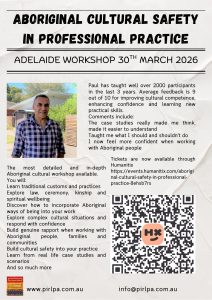
Aboriginal Culture in Professional Practice - 6 hours approx
Aboriginal Culture in Professional Practice is an all day workshop for those who work with Aboriginal people, families and
communities. Paul will teach you using traditional Aboriginal methods of learning. It is unlike any other cultural training and at the end, you will have a detailed understanding of traditional Aboriginal culture and a new set of skills that you can use in your day to day practice.
You will Learn
Traditional Aboriginal culture and practice
Kinship systems and how they work
Aboriginal spiritual model of health and well-being
The Aboriginal way of learning and how you can use it
Aboriginal law and different world views
Communication skills and techniques
Creating safe and secure spaces
The cultural handshake and how to create trust
How to work with complex Aboriginal clients
Visiting remote communities and what to do
De-escalating and behavioural management skills.
Coping skills and strategies.
Narrative Therapy techniques.
Various role plays, case studies and scenario activities
And much more.
Most recent feedback from a session held in November 2023 at a school
I recently held a 6 hour Aboriginal cultural workshop at a school. In attendance were around 20-30 staff who consisted of teachers, support workers, admin, board members and others.
My next goal is to create a 1 hour online learning module that will share key aspects of my 6 hour workshop. The skills, techniques and methods shared will be transferable and will improve outcomes when working with Aboriginal people, families and communities. This will align with organisations that have a RAP that includes learning. The online module will be level 1 and my 6 hour face to face will be level 2.
In the meantime, please read feedback from those who attended my latest workshop.
Do you believe that the cultural presentation will enhance your practice and why?
Yes, it strengthens my knowledge base particularly validating coming from a person with such strong experiences within their mob.
Yes - the information provided broadened my understanding and empathy for First Nations culture and ways of being. This will allow me to hold space and consider alternative modes of communication for more accessible and inclusive shared experiences with students.
Yes, it gives more understanding on the different ways First Nations Peoples understand the world we live in.
Yes! I think it's important to be subject to the "culture shock" that is trying to understand a very different set of conventions that someone else lives by.
Yes, more knowledgeable about family, language, customs.
Yes, I better understand how to approach communication and cultural differences.
Yes, most definitely- the training provided us with a solid foundation to better understand First Nations culture as well as practical guidance on how to build and nurture strong relationships with First Nations students. The de-escalation tips were particularly helpful Thank you.
Yes, it was awesome to have the the time and space to listen but be engaged in a way that was authentic.
What were the key themes that resonate with you following the training?
Never alone, I will be communicating this with others and holding this as an intentional standard when supporting others in my role, reminding and engraining the importance of not being alone.
Communication methods, storytelling and shame as a concept.
Forgiveness and justice - how the restorative approach is done in one day and it is centred around the love we have for each other.
The four pillars of culture and the self at the centre. I was very surprised and impressed to see this turmoil I try to understand in myself put into such a comprehendible visual.
Understanding this internal balance will help me understand myself and others.
The family structure, the importance of connection and country
Kinship, I found this really interesting and it made a lot of sense due to Paul's excellent facilitation.
That creating space for First Nations people to reconnect to culture and country can have a profound effect.
So much- better understanding two-way learning was especially helpful and I think understanding this better will improve practice all around not only with First Nations students but all students.
Understanding kinship systems and First Nations holistic health approach was especially helpful and I really appreciated the focus on First Nations culture and knowledge systems rather than a history of colonialism which has been the focus of other training I have participated in. While the latter is also crucial it was great to develop cultural competencies through understanding culture not just the impacts of colonialism.
I appreciated the section on how colonising culture and First Nations culture are in conflict and believe understanding this better will help improve practice.
Family systems, two-way learning, understanding context.
Do you feel more culturally aware following the training? If you can, please share an example.
Yes, the content around specific traditional behaviours as a community was new information as my mob does not have this level of preservation of information.
Enhanced gratitude to be living in a place seeded with such deep wisdom, stemming from a complex and sophisticated history created by First Nations communities.
Yes - How some behaviours that can seem "odd" to western culture are behaviours that are totally acceptable and expected for some First Nation People e.g. hit on the head when someone passes on.
Yes! I learnt much I hadn't known prior, like, understanding some interpersonal dynamics, like family structures. I'm not sure how to put it properly into words but I feel that I learnt important things through Paul's resources like the timeline of the Aboriginal man's life in community and the kinship system and how that family structure. It helps kill the western perspective that one may have when understanding other cultures, I notice a lot of older people come into cultural discussions trying to understand through the perspective of their own experiences.
Yes, the holistic approach and the use of natural remedies/plants etc in healing, indicate the strong connection to the land.
Yes. Example: I did not understand why First Nations people called each other brother or sister if they were not biological siblings. This is something I won't think twice about now.
Yes- I learned a lot about First Nations culture and feel that the understanding will help me improve my practice-especially the understanding of being square and specific things we can do to approach health from the holistic perspective.
Yes, for me it was not only the content but doing it as a staff together- the act of listening and sharing in together is powerful.
On a scale from 1 to 10, one being least and 10 being more- prior to the training where were you inregards to cultural competence and where are you now following the training.
Please answer for both PRIOR the training & POST training.
Before - 7 After - 9
Prior - 5 Post - 7
Prior 5 - Post 8
Im not sure how to measure this but I think I went from 5 to 7
6 and now 8
Prior: 4 Post: 7 (still have a lot to learn!)
Prior 5 Post 10
Before 7/10 now 8/10
Would you recommend the training to others?
Most definitely
Absolutely, the delivery was kind yet personable, it was serious where needed and cheeky where it deserved.
Yes
Definitely
Yes
Definitely.
Absolutely
Any other feedback
Paul it's privilege to get this time to work with you and to receive your stories shared.
Thank you for your radical transparency, patience and investment in us.
Really good and engaging - I like that there were personal stories shared. This makes the training more engaging and we as the audience can relate easier to the content.
I personally would've benefit from utilizing all breaks. As Paul said, we are taking in knowledge he's accumulated over his lifetime in a day, and I think being able to sit with the information is very important to evade mental fatigue and it lets this new knowledge have the time to be planted in my brain.
Loved it! Very informative and great delivery! (Maybe some worksheets for us to keep at the end to help us remember more would have been a nice touch).
Paul's facilitation was brilliant. He ensured that he added humour to break up what can be a very 'full on' subject matter.
All day 'talks' typically leave me feeling drained but the Cultural Awareness training left me feeling keen for more! I am quite an anxious person, but felt Paul was incredibly easy to talk to from the get-go. I did not feel a single ounce of judgement from Paul.
Just a giant thanks for generously sharing your knowledge.
Paul, I appreciated your style of communication and how you shared an idea/topic but also gave a story example, and then encouraged questions. It gave room for different styles of learning and for understanding, thank you.
Valuable connection made externally and valuable to have this brought into our organisation and the time prioritised with the whole team and not only an add on or opportunity silo.
More practical activities and less power point next time
No - I wouldn't change the training and facilitator. It would be interesting to see a female perspective in the training as well. Having a woman alongside Paul could have been useful so they could share their views on the different roles they play in the community.
Great training! Big thumbs up.l! Thankyou
Brilliant training that filled a need for us. It helps us to better understand our diverse cohort of students and the variety of challenges they go through. I don't think we could have chosen a better facilitator than Paul!
Just a giant thanks again!
Thank you for your time, effort & willingness, we are so fortunate to have you share with us and especially working with our students, staff and the camp.
Feedback from a training session held in June 2023
Around 25 staff members attended my training, they consisted of psychologists, allied health, nursing and social workers.
The training was held over 2 hours and was no different to what I would normally hold.
Here is a list of some questions I asked them along with the results.
1. What number would best represent your level of Aboriginal understanding. 1 being low understanding and 10 being a high level of understanding. This question was asked before the training and after. Participants reported an overall increase of 38% in understanding.
2. What number best describes your level of Aboriginal cultural competence. 1 being less and 5 being more. This questions was asked before and after the training. Participants reported an overall 31% increase in cultural competence.
3. Do you have some understanding of what it is like to be Aboriginal. 1 being no understanding and 5 being a detailed understanding. This was asked before and after the training session. The group reported an overall increase of 43%.
4. What was the content of the training like to understand. 1 being hard and 5 being easy to understand. Overall 98% reported that the content was easy to understand.
5. Would you recommend this training to others. 100% said yes.
General comments from attendees-
Psychologist - informative, helps me understand, really enjoyed it, learnt so much.
Allied Health worker- Engaging, valuable
Nurse- Interesting, educational
Psychologist- Fun, invaluable
Social Worker- Excellent story telling to connect us to learning
Allied Health worker- Loved it, look forward to more
Nurse- Very informative, everyone should complete it
Psychologist- important, interesting, helpful
Nurse- Very comprehensive, understanding has increased, beneficial
Unknown- Vital for all staff to attend.